Lifecycle Marketing & CRM: What to Build, What to Measure and How to Get Good at It
Lifecycle marketing is one of those niches that looks “trendy” online… until you try to implement it with real users, real data, and real pressure to drive revenue.
That’s usually when it’s important to ask questions:
- “Is lifecycle marketing the same thing as CRM?”
- “What journeys should we build first?”
- “How do we segment properly when our data is messy?”
- “How do we prove impact beyond open rates?”
- “What tools do we actually need?”
- “How do I build skills (and a portfolio) for lifecycle roles?”
It’s old thinking to think customers as people walking a straight line: Awareness → Consideration → Purchase. Real life is messy. A customer might see your ad, download your app, forget about it for three weeks, and then buy something because of a random recommendation.
This is where lifecycle marketing becomes king in the marketing loop—if done well! There’s more to learn in this article.
Build Skills; Move Your Career Forward with Treford
Join 15,000+ no-code tech professionals like you who use Treford to build skills that move their careers forward.
What is Lifecycle Marketing, Really?
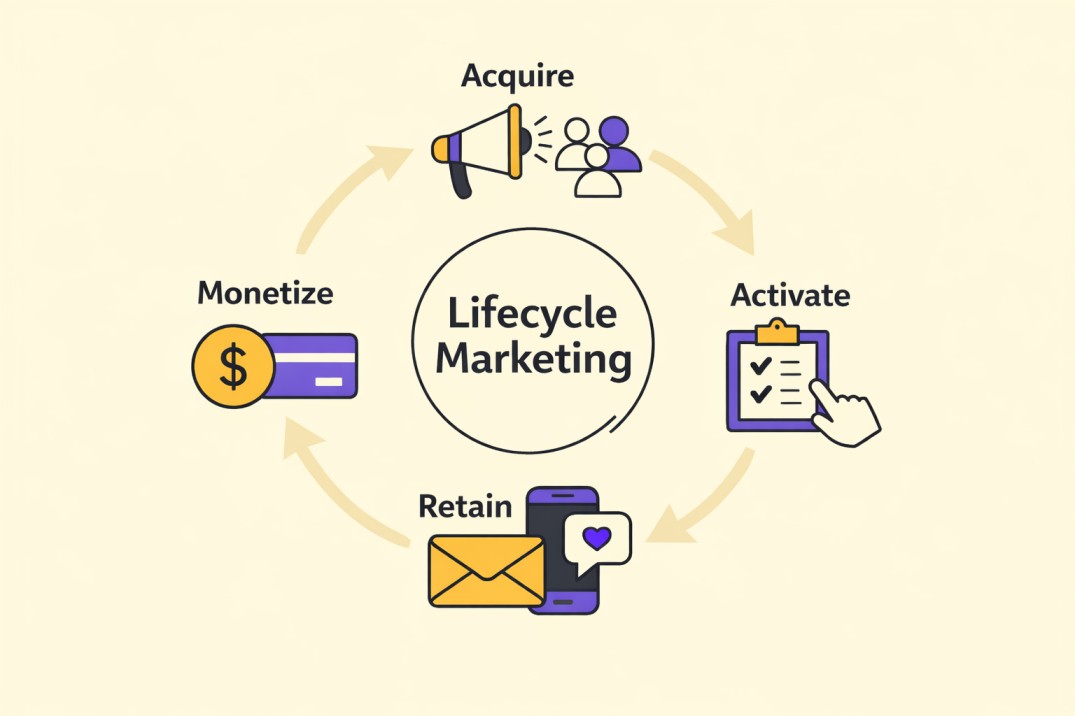
Lifecycle marketing is a strategy for engaging customers across the stages of their relationship with a brand, from first touch to post-purchase engagement and beyond.
It includes email, yes. But it can also include:
- in-app prompts
- push notifications
- SMS/WhatsApp (if it fits your audience)
- onboarding education
- renewal, rescue, and winback flows
- expansion messaging and advocacy loops
The core idea is simple: the right message + the right timing + the right segment = behaviour change.
Now, the confusion usually happens because CRM is both:
- a practice (managing relationships), and
- a system/tool used across sales, marketing and customer success.
Here is a breakdown of all the different verticals that contribute to a successful lifecycle marketing initiative:
- Lifecycle marketing – the strategy + journeys + experiments that move customers forward
- CRM – the system (and operating layer) that stores customer context and supports targeted workflows
- Retention marketing – the part of the lifecycle focused on keeping customers active and reducing churn
- Email marketing – one channel lifecycle uses (often the most common starting point)
If your plan is “send more emails,” you’ll create activity.
If your plan is “move customers to value faster and keep them there,” you’re already thinking like a lifecycle marketer
What Does a Lifecycle Marketing Manager Do Day-to-Day?
A lifecycle marketer builds repeatable systems that drive activation, retention, renewals, and expansion — without needing a new campaign brainstorm every time performance dips.
Day-to-day, that usually means:
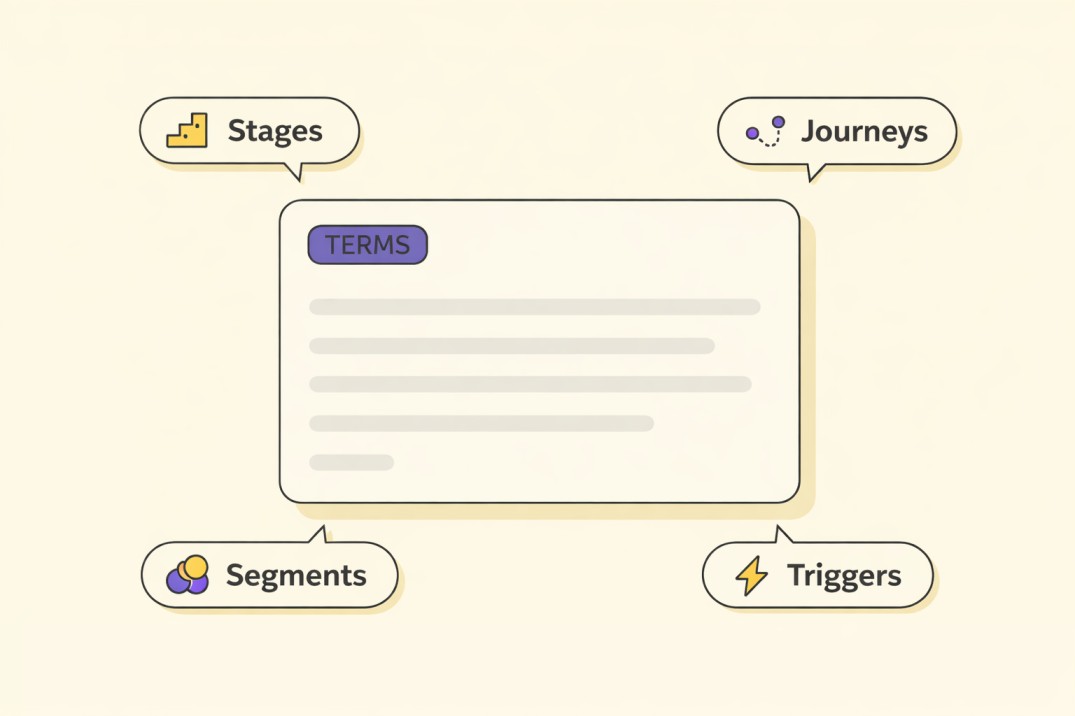
- mapping lifecycle stages (based on how users actually behave)
- defining triggers (events/behaviours) that start journeys
- building segments (new, activated, at-risk, high-value)
- creating flows (onboarding, activation nudges, adoption, rescue, re-engagement)
- QA (logic, timing, personalisation, edge cases)
- measuring outcomes and running experiments
- collaborating with Product, Data, Sales/CS, and Support

And here’s the part that you need understand clearly:
Lifecycle work is partly marketing, partly analytics, partly systems thinking. If tracking is broken, segmentation is guesswork. If the product experience is unclear, your “perfect email” won’t save retention.
In simple terms, if you become a Lifecycle Marketing manager, you will spend your day doing three things: Looking at the data, cleaning the data, building the journey, and fixing the leaks. In one of our community sessions, How to Use CRM and Lifecycle Marketing to drive customer retention, Lifecycle Marketing Manager at Flutterwave, Chiedozie Ike, emphasised this:
“Our work is to be obsessed about data. We must hunt for data, know what is happening in the messy middle, understand the relationship between churn, um engagement, activation and customer acquisitions, right? You are very important because once you know the customers who are staying. These customers are giving you good money, so you can now speak to the acquisition team and say, “Hey, I notice that people who come from this location, people who are of this race or people who who come from this referral code tend to do better than people who come from this other one. Can we focus more on this? And then find those leaks, fix them. Because without data, you are blind.”
Why Your “Lifecycle Marketing” Isn’t Improving Retention (and How to Fix It)
People who have been in the CRM or Lifecycle space for a while know this feeling.
You’ve set up your welcome flows, your abandoned cart reminders are running and you’re A/B testing subject lines. But the needle isn’t moving like it used to.
The truth is most of the “best practices” we learned five years ago are now just noise to the average customer. In 2026, people don’t want to be “managed” through a funnel; they want a brand that actually pays attention. Here is how the best in the business are changing their approach.
1. Retention Doesn’t Live Inside a Funnel
A lot of teams still run lifecycle like it’s a neat little journey:
Awareness → Consideration → Purchase → done.
But that’s not how customers behave and honestly, it’s not how products work either.
People dip in and out. They get busy. They uninstall. They come back because a friend mentions your product. They buy once, ghost for a month, then randomly return when a problem shows up again.
So when teams keep “optimising the funnel,” they end up measuring the wrong thing: the first conversion.
Meanwhile, retention is quietly bleeding out after the first “yes.”
The shift: stop treating lifecycle as a one-way pipeline and start treating it like a loop you actively design.
Becoming a lifecycle manager requires you to make sure the first purchase immediately leads to a second moment of value and the next “win” that makes the customer think:“Oh. This actually works for me. Let me keep using it.
2. Context > “Personalization”
Real personalization is context. If a user just had a failed payment or a bad support experience, the last thing they want is a “Check out our new arrivals!” email.
Lifecycle marketing says before you hit send or set up automated emails, etc. ask:
Does this message make sense for exactly what this person is doing right now? If you can’t answer that, your data isn’t talking to your marketing tools. That’s the first gap you need to close.
3. Silent churn starts way earlier than Day 30
Waiting 30 days to send “We miss you” is like showing up after they’ve already moved out. Retention teams that win watch for early drift, not full disappearance.
Track these predictive signals:
- usage frequency dropping (especially for previously active users)
- unsubscribes or reduced engagement with certain message types
- repeated friction points (stuck on the same step/page, retries, errors)
Actionable fix:
Trigger help, not discounts: guidance, quick setup, support prompts, “here’s what to do next.”
Create a “risk” segment (light drop in activity + 1 friction signal).

4. Lifecycle needs operators, not just copywriters
Being a great writer is still important, but it’s no longer enough. The role has changed. Today, the most successful Lifecycle Managers are part-strategist, part-data-detective, and part-psychologist.
You don’t need to be able to code, but you do need to understand:
- How data flows: Where does your customer info live?
- Incrementality: Did your email actually cause the sale, or would they have bought anyway?
- Psychology: What actually motivates someone to take action? (Hint: It’s rarely just a 10% off coupon).
In fact, AI now allows you to make sense of a lot of things in the shortest time possible.
This might sound a lot technical at this stage if you haven’t had any interaction with CRM tools or manage workflows before. But this is to help you start rethinking or pinpoint the leaks in your current process that makes retention or engaging your customers hard to achieve.
And if you’re building lifecycle marketing with revenue in mind, this guide on growing into marketing leadership roles is useful because it pushes you to tie work to business outcomes, not activity.”
How to Build a Lifecycle Marketing Strategy from Scratch
Chiedozie says most lifecycle programs fail because teams launch campaigns before they’ve built the engine (data, segmentation, product alignment, multi-channel delivery, and diagnosis).
In another light, some teams start from “what should we send?” instead of “what needs to change?”Use this stack instead:
Use this stack instead:
1) Start with the business goal
Pick one primary goal per cycle (per quarter or sprint). Examples:
- improve activation (new users reach “aha” faster)
- increase retention (more users return and keep using)
- reduce churn (fewer users drop off after week 1/month 1)
- improve renewals (subscription moment messaging)
- drive expansion (upsell/cross-sell for the right segment)
The goal matters because it changes what you build, what you measure, and what counts as success.
2) Define lifecycle stages for your product
Generic stages exist (awareness, onboarding, engagement, retention, winback). But your real stages should be based on actual behaviour.
Here is a simple product-led example:
- Signed up
- Completed onboarding step
- Reached activation event
- Became weekly active
- Hit a “value” threshold (usage intensity)
- Expansion-ready (team adoption / higher tier usage)
- At-risk (usage drop)
- Churned / inactive
If you use a CRM platform that supports lifecycle stages, you can model and report this more cleanly
3) Define your success events
A success event is the 1–3 actions that tell you: this person is actually getting value from the product.
Not “they opened an email.”
Not “they logged in once.”
Value signals are the behaviors that correlate with retention and revenue.
What makes a success event “real”? A good success event is:

For Example:
- Learning platform: completes first lesson + saves/downloads a resource
- Fintech: adds card/bank + makes first transaction
- SaaS: creates first project + invites teammate
- Community/product: joins community + posts/comments first time
4) Build your key segments
Segmentation is how lifecycle stays relevant. It’s what separates “helpful” from “spam.” You don’t need 50 segments to start. You need a few that actually reflect behaviour.
A minimum viable segmentation model (start here):
1) Lifecycle stage segments
This answers: Where are they in their journey?
- New
- Activated
- Retained
- At-risk
- Inactive/Churned
2) Behaviour segments (did X / didn’t do X)
This answers: What have they done that matters?
- Completed onboarding step
- Hit success event
- Used a key feature
- Viewed pricing page
- Started checkout but didn’t complete
- Logged in but got stuck on a step
3) Value tier segments (who is worth extra attention?)
This answers: How valuable is this user or customer likely to be?
- Plan type (free vs paid tiers)
- Usage depth (power user vs casual)
- LTV proxy (signals that they’ll stick and pay more)
5) Map journeys to move people forward
A journey is a planned sequence of messages and nudges that helps users move from one lifecycle stage to the next, like onboarding → activation → engagement → adoption → retention.
For each journey, keep it simple and define:
- Who it’s for (segment)
- What you want them to do (one behaviour goal)
- What triggers it (event or inactivity)
- What you’ll send and where (email/in-app/push, etc.)
- When it ends (exit condition)
- How you’ll measure success (one outcome metric)
When journeys are mapped this way, lifecycle stops being a set email drip you leave on autopilot and becomes a system you can build, test, and improve.
6) Decide your channels
Lifecycle doesn’t have to mean “all channels.” Start with what you can do well and scale from there. Choose CRM tools intentionally (budget, projected customers, etc.)
Most teams start with:
- email + in-app (if available)
Then expand to push/SMS when you have:
- clear triggers
- stable segmentation
- solid measurement
7) Measurement + experimentation plan
If you can’t measure it, you can’t defend it. And if you can’t defend it, it won’t survive budget season. Plus, stay close to data/engineering, validate what’s being fed into CRM to be sure they are tracking users and behaviours that are important to your retention and revenue goals.
Which Lifecycle Stages Should You Prioritise First?
Here’s the bitter truth: you don’t “winback” your way out of broken onboarding. You must get the basics right, else users start to churn at onboarding after you’ve probably spent a huge part of your marketing budget acquiring.
Use this prioritisation logic:
- If users sign up but never get value → onboarding + activation
- If users get value once but don’t return → habit + retention journeys
- If users drop off after a predictable point → churn prevention + rescue flows
- If renewals are weak → renewal moment journeys
- If growth needs revenue uplift → expansion journeys (for the right segments)
Here is how you should prioritise your focus, step-by-step:
This is the most critical part of the journey. Onboarding isn’t just a “Welcome” email; it’s the guided tour that shows a user how your product solves their problem.
1. Onboarding: The First Impression
Success: onboarding completion, time-to-activation, first value event
The Goal: Get them to set up their account and see value as fast as possible.
Example: If you have a fintech app, your onboarding flow should guide the user to link their bank account or make their first deposit within the first 24 hours.
2. Activation Nudges: The “Aha!” Moment
Activation is the moment the user realizes, “Oh, I get it! This is useful.” A nudge is a gentle reminder to take the specific action that leads to that realization.
Success: activation rate, time-to-activation
The Goal: Push the user toward one key activity that correlates with long-term usage.
Example: For a project management tool, an activation nudge might be an automated message saying, “You haven’t created your first task yet—here’s a 30-second video on how to start.”
3. Basic Retention/Habit: Staying Top-of-Mind
Once they’ve used the product once, you need them to come back regularly. This is about building a “habit loop” so they don’t forget you exist.
Success: cohort retention, WAU/MAU trend, repeat key action
The Goal: Provide ongoing value that encourages a second and third visit.
Example: A food delivery app sending a “What’s for lunch?” notification every Friday at 11:30 AM to build a weekly routine. See also the example below from Pinterest, trying to use a user’s search history to alert them about new arrivals. This is a way to provide value and get users to return to the app.

4. Re-engagement: The “Tapping on the Shoulder”
This is for the users who have gone quiet for a few days but haven’t fully “quit” yet. It’s much easier to bring back someone who is just “distracted” than someone who has completely deleted your app.
Success: reactivation rate, reactivated users who retain
The Goal: Remind them of the value they’re missing out on.
Example: A language learning app sending a notification saying, “Your 5-day streak is at risk! Just 2 minutes of practice will keep it alive.”
5. Winback: The Last Resort
Winback is for people who have been gone for a long time (30–90 days). In early-stage teams, this is the hardest and most expensive group to convert, so it should come last.
- The Goal: Offer a massive incentive or a “What’s New” update to convince them to give you a second chance.
- Example:“We’ve missed you! Here is 50% off your next month, and look at these 3 new features we just launched while you were away.”
A revenue-minded note: these journeys aren’t just “nice messaging.” They’re the system that protects CAC and increases LTV. If you can build even 3–5 of these properly (with segmentation logic + reporting), you’re already doing real lifecycle work.

Metrics that Matter in Lifecycle Marketing
Email metrics matter. But they’re not the point. Salesforce frames deliverability and engagement factors like sender reputation, authentication, list hygiene, and engagement. That’s useful but lifecycle success is bigger than that. So you need to think in three layers:
1) Channel metrics (signals)
- delivery rate, open rate, CTR
- unsubscribes, spam complaints
- bounce rate
2) Lifecycle metrics (behaviour change)
- activation rate
- retention by cohort
- churn rate
- reactivation rate
- expansion/upgrade rate
3) Business metrics (outcomes)
- revenue impact (where measurable)
- renewal rate
- LTV movement (directionally)
Your Next Step to Becoming a Lifecycle Marketing Manager
Marketing can’t be “set and forget” anymore. The brands that win now are the ones that send human, well-timed messages not the ones with the biggest budgets.
Lifecycle marketing is basically the role where you combine strategy + testing + customer understanding to drive retention and revenue. And you don’t need to build a massive system on day one: start with onboarding/activation, keep segmentation simple, track real behaviour change, then iterate like a product team.
If you want to go from knowing lifecycle to actually doing it, the next step is practice — building journeys, the logic behind them, and measurement that stakeholders trust. That’s what the Treford Lifecycle Marketing Program is built to help you do, with senior lifecycle managers guiding you through real work and real constraints.